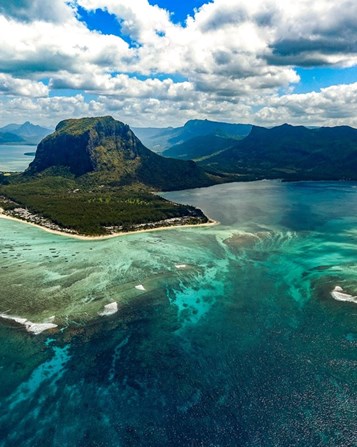
In Bel Ombre, a quiet current is building. Not just along the reef or through the mangroves, but in the way people are coming together to understand and care for the coastline they share.
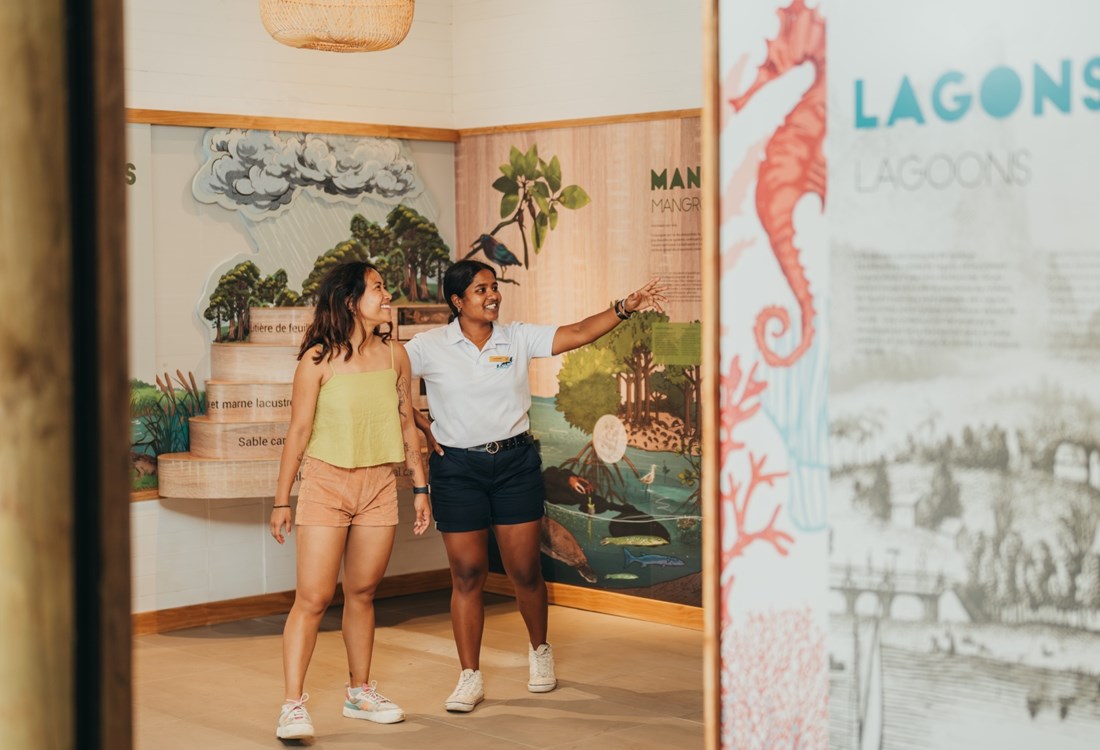
Since opening in December 2024, the Heritage Marine Education Centre has become a space where learning, dialogue, and environmental awareness intersect. Located in Bel Ombre, Mauritius, the centre has welcomed over 3,500 individuals in just six months: 2,700+ through site visits and over 750 through activities like snorkelling, mangrove observation, glass-bottom outings, and biodiversity walks. Among them, 500 were schoolchildren, educators, and group leaders, each one reinforcing the centre’s role as a space adaptable to different levels and intentions.
Set within a living landscape where forest, river, and lagoon meet, the Heritage Marine Education Centre was developed in collaboration with NGO Reef Conservation, who continue to manage its day-to-day operations and guide its educational direction. The Centre also works in close alignment with Heritage’s broader sustainability commitments, welcoming both regional partners and resort guests with the same spirit: that connection leads to care, and that care begins with time spent on site.
WHY BEL OMBRE FELT RIGHT
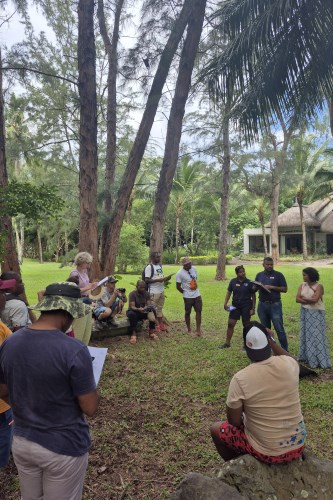
Earlier this year, the Centre was selected as one of the field sessions for the Varuna MPA project, which supports marine area managers across eight island territories in the South-West Indian Ocean. Led by NatureXpairs (Réserves naturelles de France), and co-piloted by the Office français pour la Biodiversité, with support from the Agence Française de Développement and Expertise France, the programme organises peer-to-peer exchanges and capacity-building sessions tailored to the needs of those who work daily in marine protected and conserved areas.
The decision to hold one of their capacity-building sessions, titled 'How to better communicate on your marine area', in Bel Ombre was deliberate. As Sevahnee Pyneeandy, coordinator for Varuna MPA, explained, the Centre, managed by one of the key partners of the project, offered a good field trip opportunity for the learners and stood out among other sites for its ability to translate scientific content into something approachable, practical, and rooted in the local environment. Its proximity to the field, its educational design, and the role played by NGO Reef Conservation made it a relevant place to gather, observe, and reflect.
What mattered most was not the label of the site, but the possibility it offered for meaningful exchange. Participants from the Seychelles, Madagascar, Comoros and other neighbouring territories experienced first-hand how communication tools can support conservation goals when they’re grounded in the lived landscape, Mauritius being a case in point.
SHARED OBSERVATIONS, LOCAL INSIGHTS
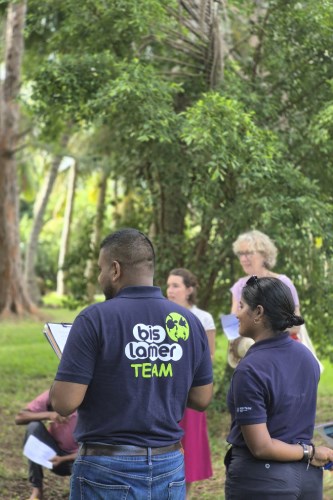
The field session at the Centre included both structured content and informal observation. A scenario-based game invited learners to reflect on how messaging needs to shift depending on the audience, whether speaking to a tourist, a policymaker, or a local fisher.
For many, this experience provided not a model to replicate, but a series of prompts, questions to carry back home, ideas to explore further, and a sense of community among peers. Eric Blais, Nature Seychelles’ Technical Operations Manager, noted that while every territory has its limits, small-scale elements such as mobile posters or adaptable outreach materials can be reimagined to fit different realities.
A FLEXIBLE TOOL FOR EVERY AUDIENCE

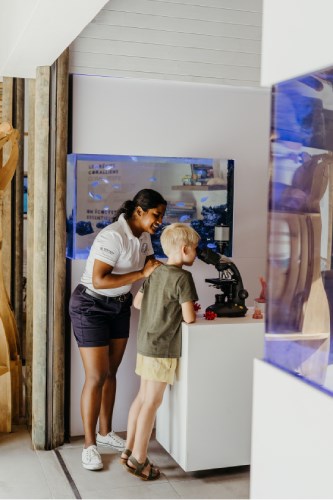
Beyond regional collaborations, the Heritage Marine Education Centre has also welcomed a variety of schools and educational institutions each with their own perspective, rhythm, and curiosity. Some arrived with a specific focus in mind, others simply wanted to spend time in a space that encourages reflection around the coastal environment. For a few, the visit was part of an established programme. For others, it became a starting point: a chance to experience how marine topics could be approached differently, and how certain elements might be useful in their own setting. In each case, the Centre offered structure to guide the visit, and enough openness to let each group shape their own experience. This quiet adaptability has been one of the Centre’s strengths. It hasn’t needed to define who it is for, its role has taken shape through the diversity of those who have chosen to engage with it.
A STEP IN A BROADER DIRECTION
The Heritage Education Centre is one part of a wider shift underway in Bel Ombre. As part of the Now for Tomorrow programme, it contributes to a growing network of actions that support long-term environmental and social resilience. More than a framework, Now for Tomorrow is Heritage's long-term commitment to working collaboratively at territory scale, to support the transitions that matter most. It centres on five impacts zones: energy transition, biodiversity preservation, circular economy, social inclusion and promotion of local communities. The Centre's role within this is clear. It offers a space to make knowledge visible, to bring together different kinds of expertise, from scientific to local, and to foster the kind of learning that doesn't aim to teach, but to connect. Through this, it continues to support Now for Tomorrow not by showcasing outcomes, but by hosting the questions that help shape them.
FREQUENTLY ASKED QUESTIONS (FAQ)
What is the Heritage Marine Education Centre?
It's a space in Bel Ombre, Mauritius, where people can learn about the ocean, coral reefs, and coastal life through fun and educational activities.
Who can visit the centre?
Everyone is welcome—students, teachers, tourists, hotel guests, or local groups.
What can you do there?
You can go snorkelling, explore mangroves, join a biodiversity walk, or take a ride on a glass-bottom boat.
Is the Marine Education Centre suitable for school visits?
Yes! Many schools visit the centre. Activities are adapted to suit kids, teens, and teachers.
Why is the Marine Education Centre important?
It helps people understand and care for the ocean. It also supports sustainable tourism and environmental education in Mauritius.